Overview
StreamSafe operates in the live streaming and social media compliance space, helping platforms keep their video, audio, and chat feeds safe for users. Based in the UK with a team of 15 to 25, the company needed to moderate content at the speed live broadcasting demands, where a harmful clip seen for even a few seconds can do real damage.
Background
When StreamSafe approached Red Star Technologies, their moderation still leaned heavily on manual oversight. Human reviewers could not keep pace with millions of live events flowing in every hour, and harmful content often slipped through before anyone flagged it. They needed to replace that reactive process with a multimodal AI engine fast enough to make decisions in under 1.5 seconds, across text, video, and audio at once.
We built an event-driven architecture using Kafka and vector search, capable of handling millions of events per hour with high precision.
Tech Stack Used:
- Frontend: Next.js (SSR optimized)
- Backend: Node.js + Express
- Event Streaming: Apache Kafka
- AI Integration: OpenAI GPT-4o + Hugging Face Transformers
- Database: Weaviate (Vector Search) + PostgreSQL
Initial Challenges
A detailed discovery process surfaced three core problems that shaped the build.
1. Processing Volume
The system had to handle over one million concurrent events per hour across chat, video frames, and audio, without dropping data or falling behind during traffic spikes.
2. Contextual Understanding
Simple keyword matching wasn't enough. The engine needed to catch sarcasm, coded language, and subtle intent, the kind of nuance that trips up basic filters.
3. Search Latency
Moderators needed to surface similar past violations instantly, pulling relevant matches from millions of historical data points without a noticeable wait.
Strategy Implementation
Our approach rested on three pillars: a resilient ingestion pipeline, multimodal AI fusion, and semantic search.
1. Kafka-Driven Ingestion Pipeline
We built parallel Kafka topics for chat, video frames, and audio snippets. Separating the streams let the system manage backpressure during spikes and stay fault-tolerant, so no event was lost even at peak load.
- Dedicated topics per content type for clean parallel processing
- Backpressure handling to absorb sudden traffic surges
- Fault tolerance to guarantee no dropped events
2. Multimodal AI Fusion
Rather than one model, we combined three. GPT-4o handled text safety, Vision Transformers scanned video frames for explicit visuals, and Whisper analyzed audio for tone and intent. Together they gave the engine a full picture of each live stream.
- GPT-4o for nuanced text and intent detection
- Vision Transformers (ViT) for visual content scanning
- Whisper for tone-aware audio analysis
3. Semantic Similarity via Vector Search
We integrated Weaviate to store content embeddings, so moderators could retrieve related violation patterns in under 500 milliseconds. This turned a slow manual lookup into an instant, context-rich reference.
Results Achieved
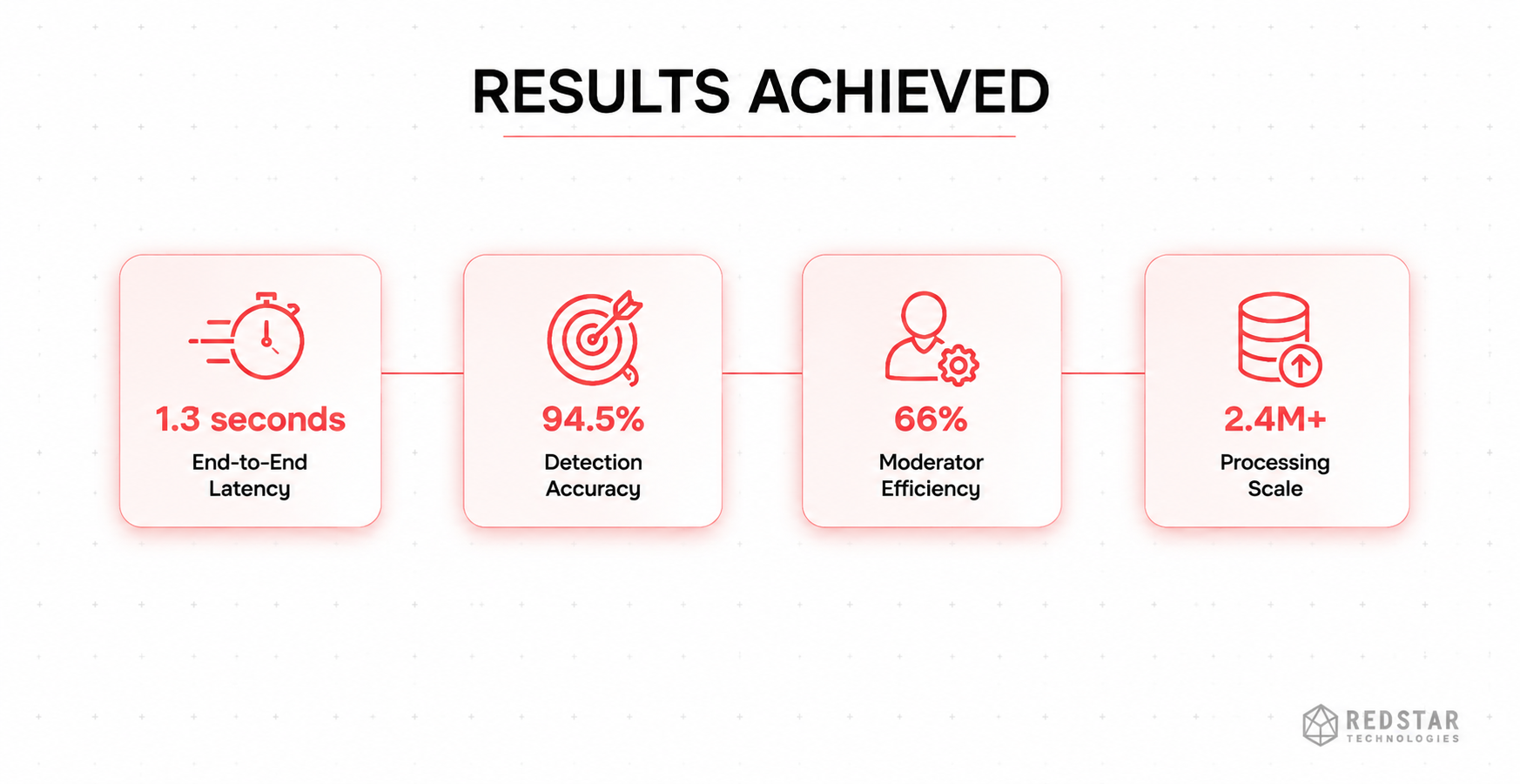
After deployment, the platform delivered measurable performance gains.
1. End-to-End Latency
The system reached an average end-to-end decision time of 1.3 seconds, comfortably under the 1.5-second target.
2. Detection Accuracy
AI detection accuracy hit 94.5%, sharply reducing the volume of harmful content reaching viewers.
3. Moderator Efficiency
Manual review time per violation dropped by 66%, freeing the team to focus on edge cases instead of routine flags.
4. Processing Scale
The pipeline processed over 2.4 million daily multimedia events with zero data loss.
Testimonial
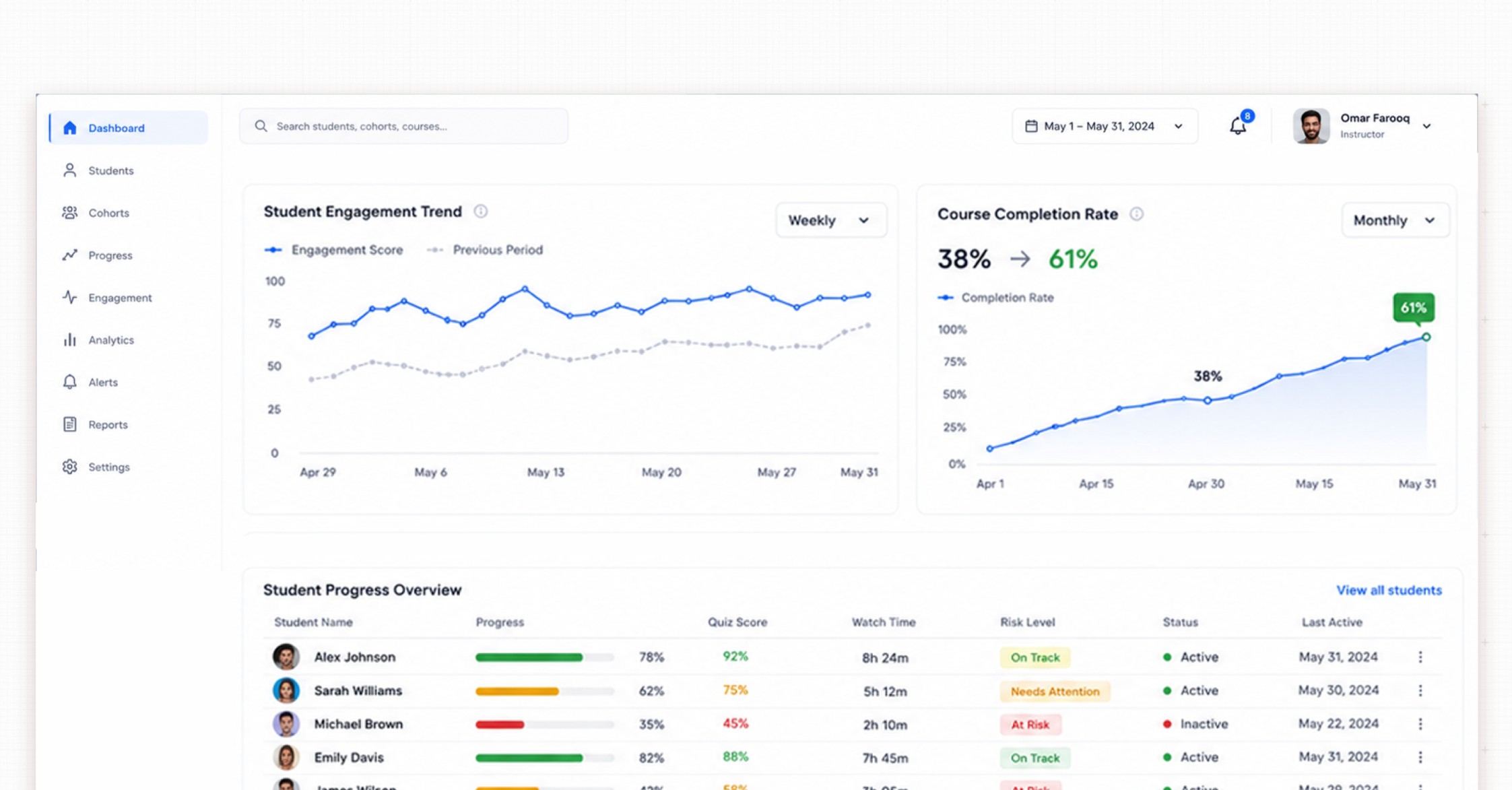
"The AI dashboard transformed our workflow. Instead of chasing individual reports, we now have global visibility into offending patterns with contextual assistance. The Kafka pipeline is lightning-fast."
— Sarah J., Chief Compliance Officer, StreamSafe
Tech Stack Summary
|
Component |
Tool / Framework |
|
Frontend |
Next.js |
|
Streaming |
Apache Kafka |
|
AI Models |
GPT-4o + ViT |
|
Vector DB |
Weaviate |
|
Infrastructure |
Docker + Kubernetes |
Lessons Learned
- Event-driven architectures are essential for real-time scalability.
- Vector databases provide critical semantic-level insights that traditional SQL cannot.
- Early monitoring setup (Prometheus / Grafana) is vital for tracking microservice latency.
Conclusion
StreamSafe needed moderation that could match the speed and scale of live digital content, something manual oversight could never deliver. By merging event streaming with multimodal AI and vector search, Red Star Technologies built a system that makes accurate safety decisions in 1.3 seconds and processes millions of events a day without loss.
The result is a next-generation moderation workflow that keeps pace with live content as it grows, giving StreamSafe both the speed and the contextual insight their compliance work demands.

 September 14, 2026