Overview
Managing inventory across multiple warehouses, suppliers, and sales channels can become complicated quickly. For manufacturers, distributors, and logistics providers, even a small gap between what's actually in stock and what's recorded in the system can lead to over-ordering, stockouts, delayed fulfillment, and unnecessary carrying costs.
Initial Challenge
The challenge wasn't simply having too much or too little inventory. It was having the right inventory, in the right warehouse, at the right time while demand was constantly changing.
Background
Red Star Technologies engineered a cloud-based supply chain and inventory intelligence platform to bring those moving parts into one system. Instead of relying on disconnected operational data and manual procurement decisions, businesses could see inventory in real time, forecast demand, coordinate with suppliers, and automate replenishment from a single platform.
What Red Star Technologies Did
- Centralized inventory management with real-time synchronization across warehouses, retail channels, and external marketplaces, supported by Redis-based inventory locks and event-driven stock updates to maintain accuracy during high-volume transactions.
- AI demand forecasting using historical sales, seasonality, market trends, and external demand signals, with Python-based FastAPI microservices using TensorFlow and Scikit-learn models with scheduled retraining pipelines to continuously support forecasting accuracy.
- Developed a smart replenishment engine that considered demand velocity, supplier lead times, safety stock requirements, and warehouse capacity before recommending new inventory.
- Automated procurement with purchase-order generation, approval workflows, supplier communication, and threshold monitoring, supported by Laravel queues and background job processing.
- Created a dedicated supplier portal where vendors could receive purchase orders, update delivery timelines, upload shipment documentation, and communicate directly with procurement teams.
- Integrated logistics, accounting, and e-commerce platforms, including Shopify, WooCommerce, FedEx, UPS, and QuickBooks to keep operational data connected.
- Implemented Redis-backed inventory locks and event-driven stock updates to maintain accuracy while processing thousands of concurrent transactions.
- Real-time analytics dashboards built with Vue.js 3, Pinia, Chart.js, and WebSockets, providing interactive inventory, sales, and operational visualizations.
- Warehouse operations were supported by CSV and Excel import pipelines for bulk product uploads, along with barcode and QR code generation for warehouse identification and operational workflows.
The Results
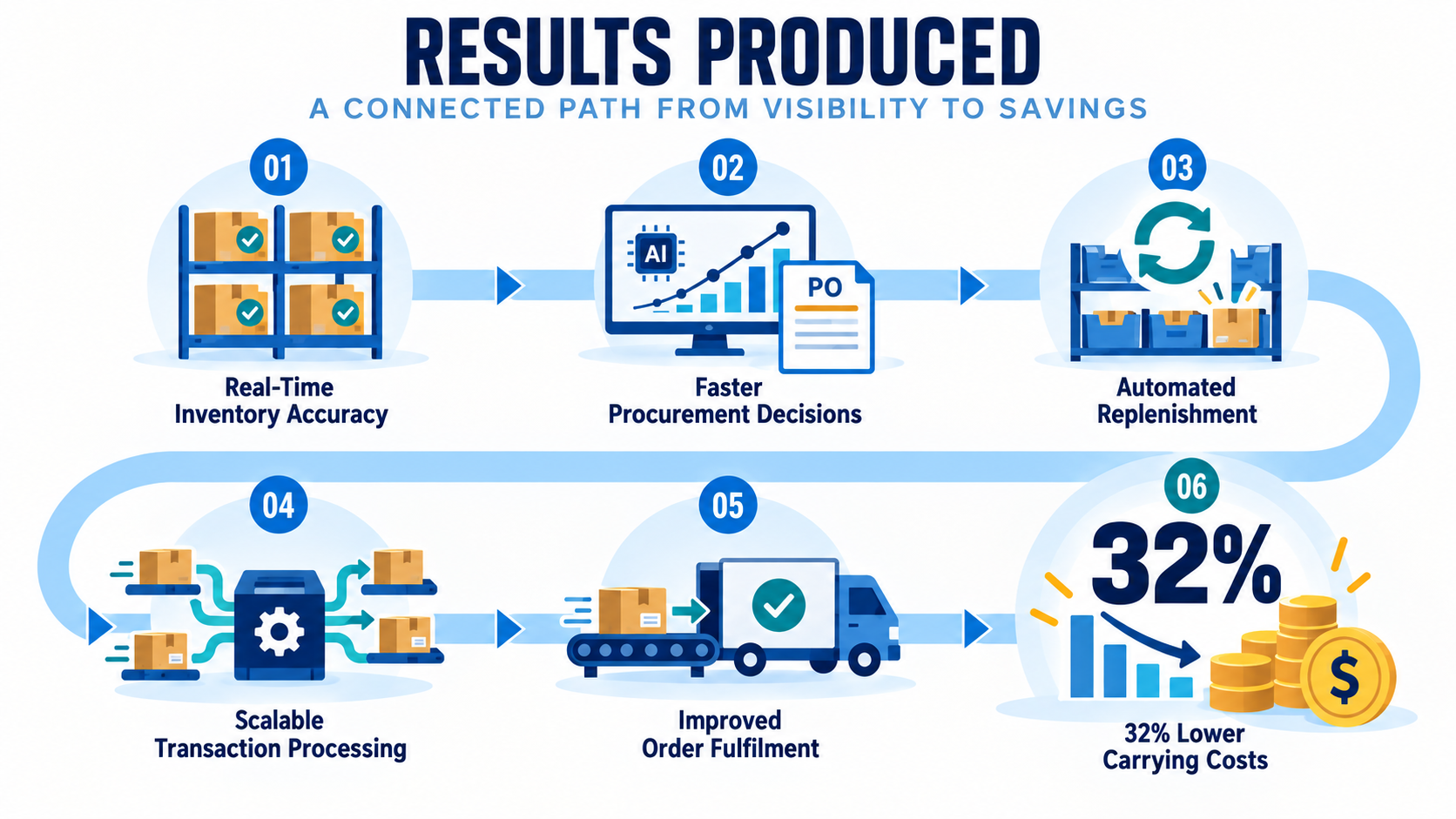
- 32% Reduction in inventory carrying costs
- Improved order fulfillment rates for enterprise clients
- Real-time inventory accuracy across multiple warehouses and sales channels
- Faster procurement decisions through AI-driven demand forecasting
- Automated replenishment and purchasing workflows
- Scalable processing for high-volume concurrent inventory transactions
The biggest improvement wasn't just a better dashboard. It was having one reliable picture of what was happening across the supply chain.
Procurement teams could make purchasing decisions based on predicted demand rather than guesswork. Warehouse teams had real-time visibility into stock levels. Suppliers could manage orders and delivery updates directly through the platform. And businesses could reduce the amount of money tied up in unsold inventory.
A Connected Supply Chain
The platform also connected the systems businesses already depended on. E-commerce stores could synchronize product and order data. Logistics APIs provided shipment tracking and delivery updates. The QuickBooks integration supported accounting synchronization. Slack and Twilio delivered operational alerts and shipment notifications.
Meanwhile, suppliers had their own portal for purchase orders, delivery updates, and documentation. Instead of forcing teams to jump between disconnected systems, the platform created a connected operational layer across inventory, procurement, suppliers, orders, and logistics.
In Their Own Words
"Before this platform, our inventory data was spread across different systems, which made it difficult to know exactly what we had and when we needed to reorder. Having real-time visibility, automated replenishment, and better demand forecasting has made our procurement process much more efficient. We're now making inventory decisions based on actual data instead of reacting after problems occur."
A Note on Results
Results will vary depending on inventory volume, supply chain complexity, product mix, demand patterns, and how effectively teams adopt the system.
The 32% reduction in inventory carrying costs represents the outcome achieved in the implementation described here. The platform's purpose was not simply to automate existing processes, but to give businesses better information for making inventory, procurement, and fulfillment decisions.
Technology creates visibility and automation. The final results still depend on how the business uses that intelligence.
Ready to Build a Smarter Supply Chain?
If your teams are still managing inventory across disconnected systems, reacting to stockouts, or carrying more inventory than they need, the right technology can change how the entire operation works.
Tech Stack Summary
|
Component |
Tool / Framework |
|
Backend |
Laravel 11, MySQL 8.0, Redis, Laravel Horizon, Event-Driven Architecture |
|
Frontend |
Vue.js 3, Pinia, Inertia.js, Tailwind CSS, Chart.js, WebSockets |
|
AI & Forecasting |
Python, FastAPI, TensorFlow, Scikit-learn |
|
Search & Data Processing |
Elasticsearch with Custom Indexing |
|
Security & Access Control |
Laravel Sanctum, Role-Based Access, Encrypted Supplier Communications |
|
Infrastructure |
Docker, Kubernetes, AWS RDS, Amazon S3, GitHub Actions |
Conclusion
Businesses with complex supply chains needed inventory management that could match the pace of real-time demand, something disconnected systems could never fully deliver. By merging centralized inventory data with AI-driven demand forecasting and automated replenishment, Red Star Technologies built a platform that reduces carrying costs by 32% and gives teams real-time accuracy across every warehouse and sales channel, turning inventory management from constant reaction into informed, data-driven decision-making.

 September 14, 2026