Overview
FrostBridge Logistics – A cold chain logistics company specializing in temperature-controlled transportation, storage, and distribution of fresh produce and pharmaceutical products.
FrostBridge Logistics moved 22,000 pallets of fresh produce and biologics each day across eight distribution centers and 470 refrigerated trucks. Yet its temperature monitoring process could only reveal what had happened after a delivery was complete.
USB data loggers were downloaded at the end of each journey. By the time a temperature breach was discovered, often a full day later, the shipment had already been unloaded and mixed with other inventory.
Red Star Technologies built ChainPulse, a real-time cold chain monitoring platform that connected pallet-level sensors, predictive shelf-life modeling and automated quality workflows. The implementation reduced annual spoilage-related write-offs by 74% and raised on-time delivery within cold chain specifications to 99.6%.
Initial Challenge
FrostBridge had temperature records, but those records arrived too late to support action during transit.
One in every 18 long-haul shipments experienced a temperature excursion exceeding safe limits. The business reported a 9% spoilage rate and $14.2 million in annual product write-offs.
The consequences extended beyond damaged stock.
1. Temperature Breaches Discovered After Delivery
When teams finally reviewed the journey’s temperature history, affected products might already have entered warehouse inventory.
There was no live warning to help operators intervene, redirect a shipment or arrange backup cold storage. Trucks kept moving while the condition of their loads remained unknown.
2. Uncertainty About Remaining Shelf Life
Temperature history could affect product quality even when a shipment was not rejected on a simple threshold check.
FrostBridge needed a way to estimate the effect of that history on remaining shelf life. Without it, downstream customers sometimes rejected products as a precaution, adding to avoidable waste.
3. Slow Quality Holds and Disputes
QA teams exchanged spreadsheets and emails with suppliers and carriers to investigate incidents and determine responsibility.
Resolution took nine days on average. During that time, quarantined products occupied cold-storage space and invoice payments were delayed.
4. Drivers Without Timely Decision Support
Drivers could not see temperature excursions developing inside their trailers. They also lacked guidance on what to do next.
A useful response required more than an alert. It needed to connect the warning with an appropriate action, such as a refrigeration adjustment or diversion to an available cold-storage location.
5. Time-Consuming Audit Preparation
Shipment temperature logs had to be reconciled manually for food safety audits.
This consumed 11,000 person-hours annually, adding a substantial administrative workload to the quality team’s responsibilities.
Background
FrostBridge needed an end-to-end cold chain monitoring system that could identify developing risks, support intervention during transit and preserve the evidence needed for quality reviews.
The project targets were to reduce spoilage-related write-offs by 70%, cut audit preparation time by 80%, achieve 99.5% on-time delivery within cold chain specifications and recover $9.5 million annually within 18 months.
We developed ChainPulse around three connected capabilities: live pallet monitoring, predictive quality assessment and automated case management.
Live pallet monitoring pipeline
- 01 Pallet sensor tags
- 02 Vehicle gateway
- 03 MQTT ingestion
- 04 TimescaleDB
- 05 LSTM shelf-life engine
- 06 Alerts & quality holds
Sensor readings were combined with GPS locations and shipment records. Predictions informed warnings and quality-hold recommendations, while drivers and operational teams received updates through shared dashboards and a mobile app.
The aim was to give people time to act while the shipment was still on the road.
Solution Design and Implementation
1. Created a Pallet-Level Digital Twin
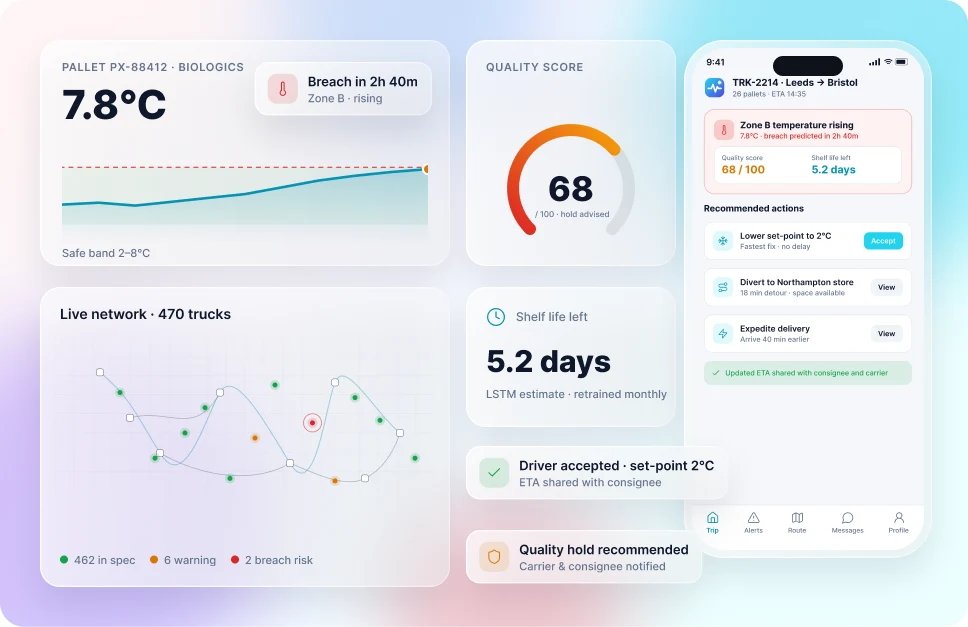
Each pallet received a LoRaWAN/BLE multi-sensor tag measuring temperature, humidity and shock. Readings were transmitted every 30 seconds to vehicle-mounted gateways and ingested through MQTT into TimescaleDB.
2. Connected Condition Data with Shipment Context
Sensor telemetry was combined with GPS and shipment master data. A React map showed pallet conditions and used green, yellow and red indicators based on predicted time to a threshold breach.
3. Built a Predictive Shelf-Life Engine
A Python/FastAPI service processed each pallet’s temperature history using an LSTM model trained on product-specific degradation kinetics. It generated updated estimates of remaining shelf life, a quality score from 0 to 100 and time to a threshold breach. Models were retrained monthly using new microbiology laboratory data.
4. Automated Quality-Hold Recommendations
When a quality score fell below a client-defined threshold, Laravel generated a hold recommendation and notified the carrier and consignee. This brought the issue to their attention before the shipment reached the dock.
5. Created Shared Digital Quality Cases
Predicted breaches triggered cases containing sensor history, GPS waypoints and timestamped events. Suppliers, carriers and customers could access the same incident evidence through the connected workflow.
6. Supported Preliminary Accountability Assessment
Automated dispute logic used geofence entry records and refrigeration set point logs to assign preliminary responsibility. This supported investigation without treating the initial assessment as a final liability decision.
7. Equipped Drivers with a Mobile Copilot
The React Native app delivered warning-state alerts and decision guidance, including refrigeration adjustments, backup cold-storage diversions and expedited delivery options. Accepted recommendations were logged, and updated arrival estimates were shared with stakeholders.
8. Delivered Live Operational Updates
Laravel Reverb and WebSockets powered pallet condition maps, quality-hold broadcasts and reroute instructions. ERP connectors and EDI messages connected the platform with existing shipment and business workflows.
The Results
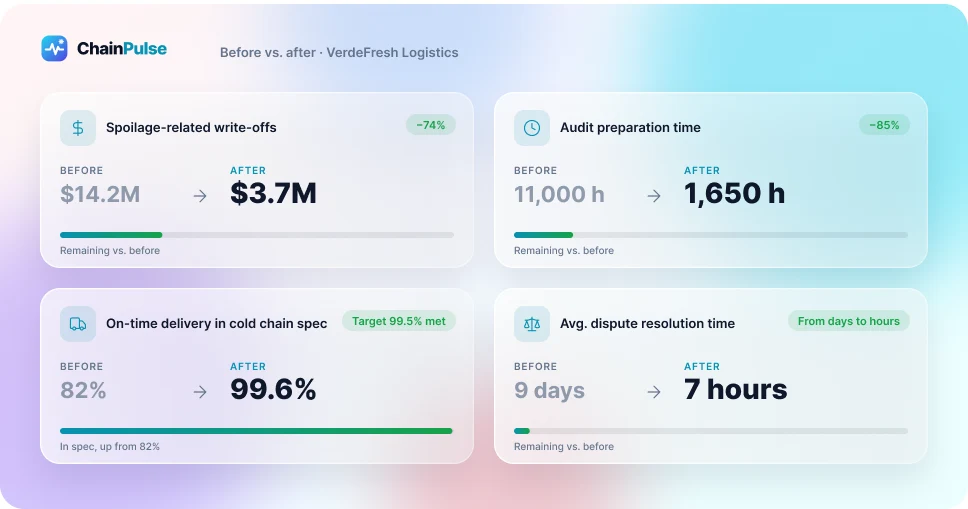
FrostBridge reported improvements across product loss, audit workload, delivery performance and incident resolution.
| Measure | Before | After |
|---|---|---|
| Annual spoilage-related write-offs | $14.2 million | $3.7 million |
| Annual audit preparation time | 11,000 hours | 1,650 hours |
| On-time delivery within cold chain specifications | 82% | 99.6% |
| Average dispute resolution time | 9 days | 7 hours |
Additional reported outcomes included:
74%
Reduction in spoilage-related write-offs
Rounded from reported annual figures
85%
Reduction in audit preparation time
11,000 → 1,650 hours a year
62%
Reduction in customer rejection rate
Fewer precautionary rejections
$2.1M
New premium-service contracts
Stronger pharma relationships
The annual write-off figures represent a reduction of $10.5 million in product losses. That figure describes avoided write-offs; it does not account for platform implementation or operating costs.
The operational change was just as significant. Teams could identify a developing problem during transit and use a shared record to manage the response. Quality investigations no longer depended on assembling evidence from separate spreadsheets after delivery.
A Connected Cold Chain
- ChainPulse brought the condition of a shipment into the decisions surrounding it.
- Drivers received warnings and action guidance. Operations teams could review location and predicted risk. QA teams had a digital case with the supporting evidence already attached. Carriers and customers received updates through the same connected process.
- That connection helped close the gap between detecting a problem and responding to it. An alert had somewhere to go, and the response could be recorded.
- The platform also made audit preparation more manageable. Sensor readings and incident events were captured within the shipment workflow, reducing the manual reconciliation that had previously consumed thousands of hours.
Ready to Improve Visibility Across Your Cold Chain?
If temperature problems are being discovered only after delivery, your teams may be missing the opportunity to intervene.
Red Star Technologies can help connect sensor telemetry, shipment data and quality workflows into a custom cold chain monitoring platform. Share how you monitor loads today, where visibility breaks down and how your teams handle exceptions.
Talk to Our TeamTech Stack Summary
| COMPONENT | Tool / Framework |
|---|---|
| Command Center, QA Dashboard & Customer Portal | React |
| Driver Mobile App | React Native |
| Ingestion, Alerts & Compliance Workflows | Laravel 11 |
| Predictive Model Serving | Python, FastAPI |
| Telemetry Storage | PostgreSQL, TimescaleDB |
| Shipment State Cache | Redis |
| Live Updates | Laravel Reverb, WebSockets |
| Pallet Sensors | LoRaWAN/BLE temperature, humidity and shock tags |
| Location & Dock Tracking | GPS fleet trackers, RFID dock-door readers |
| Predictive Modeling | LSTM neural network |
| Sensor Ingestion | MQTT broker |
| Shipment & ERP Integration | EDI 856/214, SAP and NetSuite connectors |
Conclusion
FrostBridge Logistics needed to understand shipment conditions while there was still time to respond.
ChainPulse connected real-time monitoring with predictive quality assessment, driver guidance and shared incident workflows. The implementation reduced spoilage-related write-offs by 74%, cut audit preparation time by 85% and achieved 99.6% on-time delivery within cold chain specifications, giving teams earlier visibility and a clearer path from warning to action.